Developing a successful product in mechanical design is not limited to just creating a three-dimensional model. How the product will behave in real operating conditions, what environmental and mechanical effects it will be exposed to, how suitable it is for production, and whether it will remain reliable in the long term must be evaluated from the very beginning of the design process.
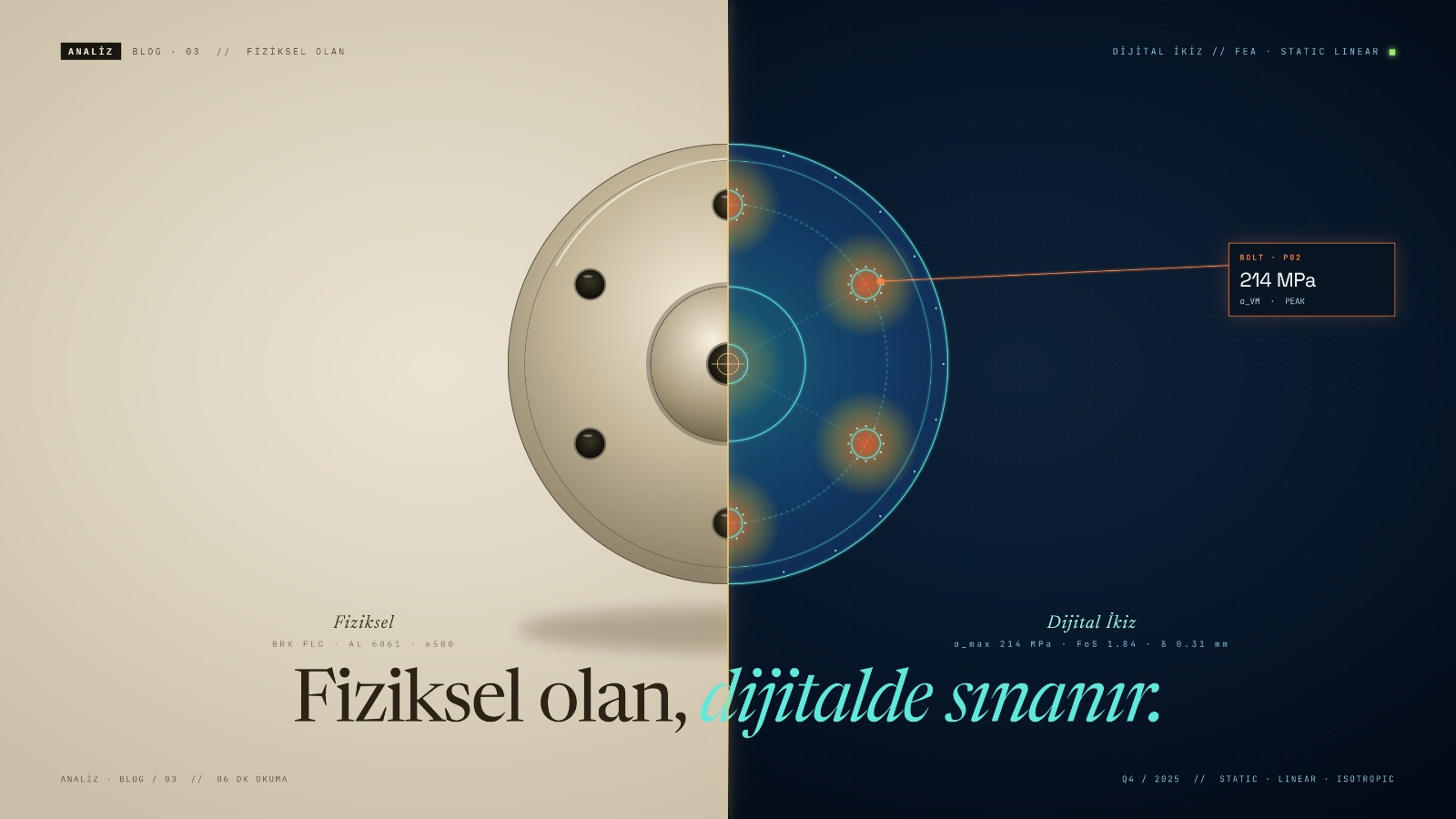
This is where digital twin and simulation-driven design comes to the fore. Before the product is physically manufactured, it is modeled in the digital environment, examined under various conditions, and evaluated from an engineering perspective. This way, weak points in the design can be identified at an early stage, necessary improvements can be made before prototype costs arise, and the product development process becomes more controlled.
Validating Design with Simulation
Every mechanical product has different operating conditions and requires different types of analysis. While some products prioritize strength and deformation, in others, thermal management, vibration behavior, mobility, assembly safety, or environmental durability may be more critical. For this reason, the simulation process must be planned according to the product's usage scenario and technical requirements.
In simulation-driven design, the product's geometry, material properties, boundary conditions, loads, and operating environment are evaluated in the digital environment. The results reveal which areas of the product require improvement, whether the design is safe, and which points need to be reviewed before moving to production.
For example, in an electronics device enclosure, screw connection points, mounting feet, body rigidity, connector areas, or heat dissipation can be examined. In an industrial product, load-bearing parts, connection plates, moving mechanisms, vibration effects, or load-transmitting zones can be evaluated. Where necessary, wall thickness can be changed, support geometries can be added, corner radii can be adjusted, material selection can be revised, or the connection structure can be improved.
Fewer Revisions, More Controlled Product Development
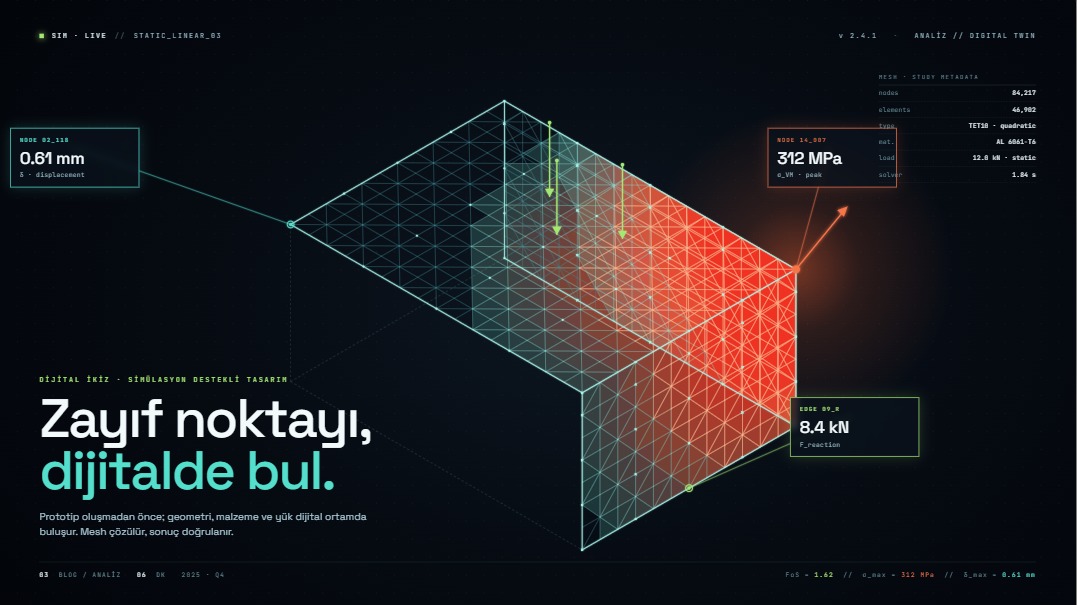
Producing prototypes is important in the product development process; however, seeing every problem on a physical prototype can result in time and cost losses. Especially in projects requiring CNC machining, sheet metal fabrication, mold production, or custom part manufacturing, each revision creates a new production cost.
With simulation-driven design, the first prototype is approached with a more mature design. This approach reduces unnecessary trial-and-error processes and makes the product development process more predictable. The design team can evaluate earlier whether parts have sufficient strength, whether excess material is being used, which areas pose assembly risks, and whether the design is compatible with the manufacturing method.
This provides advantages not only technically but also commercially. Fewer revisions mean shorter development time and more controlled costs. Especially for products that need to reach the market quickly, digital validation processes provide companies with a significant competitive advantage.
Production-Ready Mechanical Design
The fact that a prototype works does not mean the product is ready for mass production. A mechanical design intended for production must be durable, manufacturable, assemblable, serviceable, and compatible with quality control processes.
Digital analyses are an important part of this preparation process. When the design is evaluated in terms of operating conditions, manufacturing method, material selection, connection safety, and product lifespan, pre-production risks are minimized. In this way, the product becomes not just a visually completed model, but an engineering-validated solution.
This approach makes the mechanical design process more conscious. Design decisions are not based solely on estimates or visual evaluation; analysis results, engineering experience, and manufacturing requirements are considered together.
Conclusion
Digital twin and simulation-driven mechanical design brings speed, confidence, and control to the product development process. Before the product is physically manufactured, different engineering scenarios can be evaluated in the digital environment, weak areas can be improved at an early stage, and the prototyping process can be made more efficient.
A successful mechanical product is not just one that is modeled, but one that is analyzed, validated, and made production-ready. This approach helps companies transform their ideas into safer, more economical, and more sustainable products.